Last Updated on Feb 9, 2026 @ 4:34:05 AM.
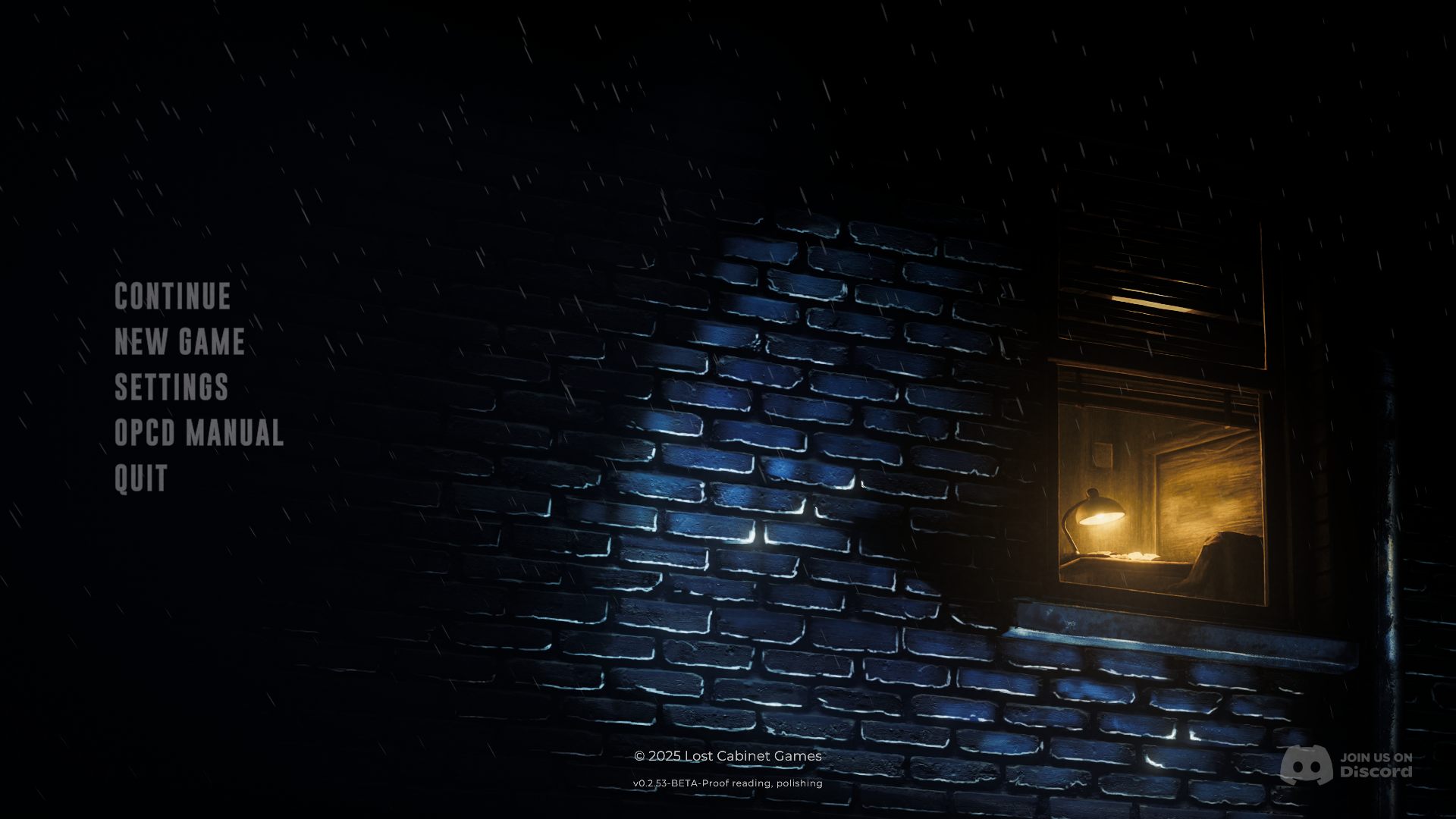
After the demo’s release during Steam’s Detective Fest, I was able to talk to the developer behind the upcoming game, Obsidian Moon, regarding said title and its noir detective gameplay, and the devs had a lot to say regarding this up-and-coming title.
During this interview, we managed to talk about a lot of different details within Obsidian Moon, whether that be the game’s text-based gameplay and how the devs were able to differentiate between important and non-important information, the various stories and how they are pieced together, both as a singular over-arching story as well as individual cases, and we even spoke about the various means to solve said cases that the player can utilize, and so much more!
| EDITOR’S NOTE |
|---|
| Due to this being a written interview, some answers have been edited for clarity/brevity, without removing intent or context. |
First of all, thank you for taking the time to talk to me. So our readers know, can you tell us your name and what your role is within the development of Obsidian Moon?
Thank you too, Liam, for the opportunity to talk about Obsidian Moon, a project that we love so much. And hello to your Readers, and to our Team, Community, and Players! I am Yannis Antonakakis, the producer and game designer of Obsidian Moon.
One of the biggest questions gamers will likely have regarding Obsidian Moon will be what inspired its creation. Can you tell us a little about this?
Sure! I am a big fan of crime literature, and I love noir detective mysteries of all formats: movies, games, books, you name it! Over the years, we have played great detective games (Sam & Max is probably one of my favorite series, along with Sierra’s many titles).
Most of them, though, are quite linear in the way the story is delivered, but also more or less restrictive regarding player agency. What if the game did not restrict the player to investigate in only one specific way? For example, to extract a confession from a suspect, typically you are asked to do the legwork, gather evidence, connect them to the suspect, etc., until you have a strong enough case to charge them, right? Why not be free to take the badass approach, stick the gun to their head, and let the metal do the talking (and pay the price)?
This is the core principle and greatest inspiration behind Obsidian Moon: the freedom to investigate the way we want and face the consequences of our choices.
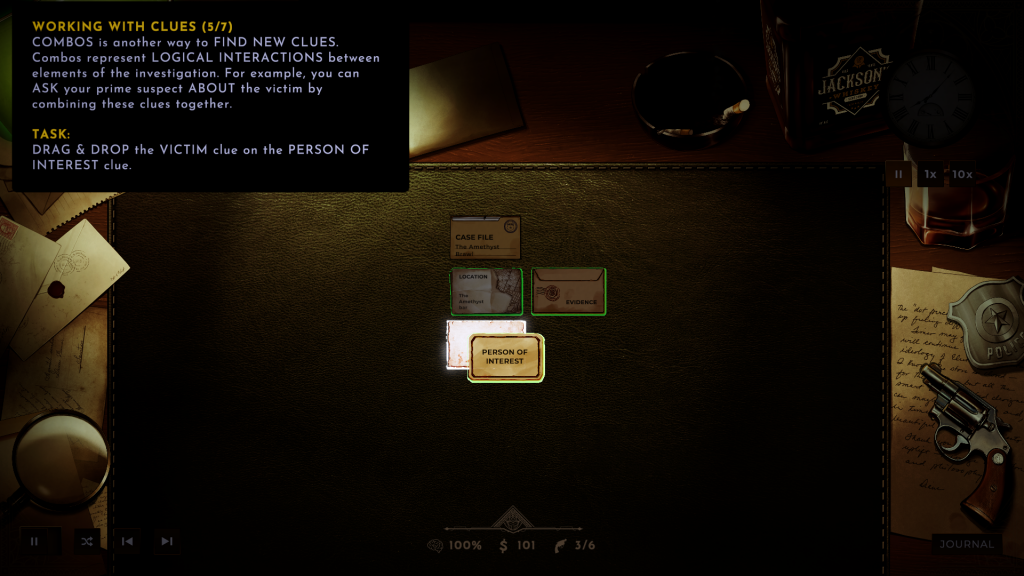
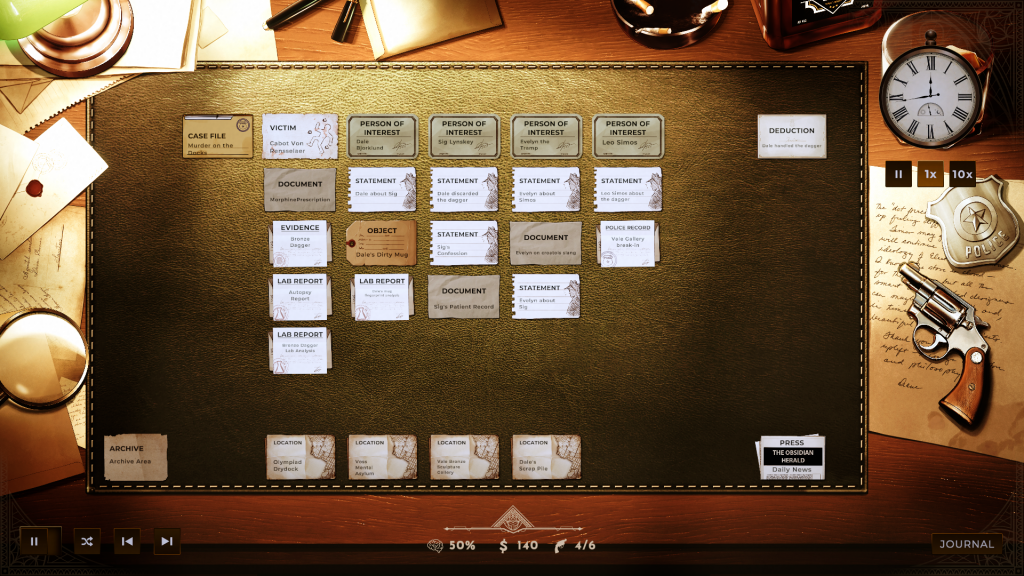
Jumping right in, Obsidian Moon is a text-based story that tasks the player with uncovering information and piecing it together in a murder board style. Can you tell us why you chose this style rather than a physical investigation?
The easy answer is that we wanted to do something really unique, but the deeper truth is that everything about Obsidian Moon, including how the gameplay is designed, is about delivering investigative freedom and unrestricted player agency.
This format allowed us to reduce the world-building complexity so that we could focus on creating a mystery that the player can unravel according to the effort given and choices made. Another considerable reason behind our design was that it eliminated distraction, allowing the player to focus on detective work. The choice of using a card-game gameplay style also complemented our approach because cards and text work very well together!
In terms of the text-based gameplay, there is a lot of information thrown at the player that they need to keep track of. Can you tell us how you were able to work around these challenges and ensure players wouldn’t get overwhelmed or lost?
Great question! Indeed, each clue you find may reveal case leads as well as pieces of lore. Obsidian Moon builds its backbone story gradually, and each player will be able to piece together their version of the story based on the information they have discovered. Being able to control the flow and timing of information required a great deal of design and playtesting, but it is the gameplay itself that gives you the tools as a player to manage this complexity – the game asks you to take your time, go through the clues, arrange and rearrange them, find connections, and act.
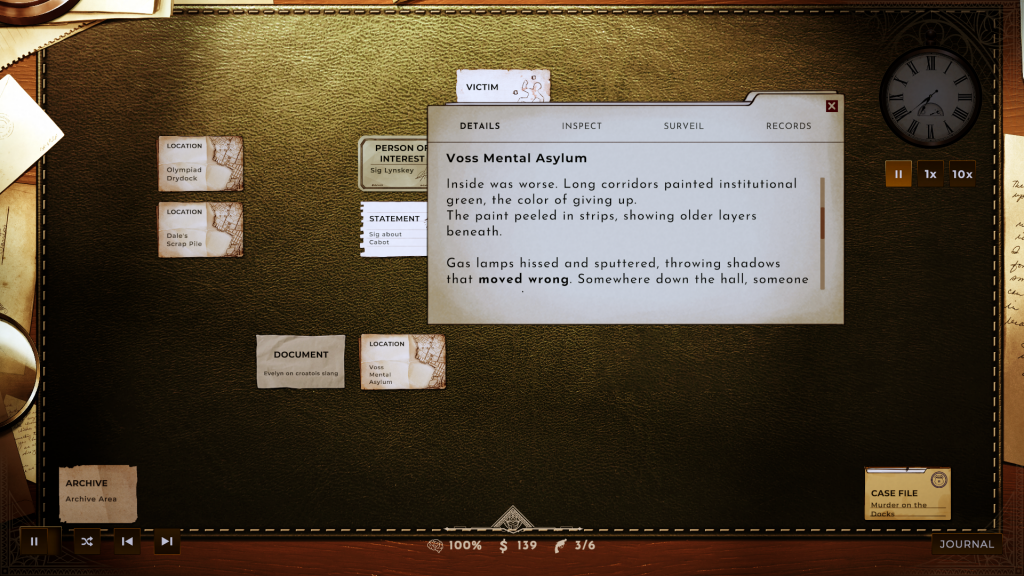
There are several mechanics to help players manage the investigative complexity. Some are already in place, and you can find them in the demo. For example, the journal keeps track of the story fragments you have discovered and of the subtle hint system that eliminates by default certain actions that do not make sense. There are also several other mechanisms that we are developing in this direction, for example, pointing out any actions that have already been taken. As long as we continue to get valuable feedback from our community, we will keep improving the game in every aspect to make it accessible to most players.
As with any detective game, there are a lot of plots to follow and mysteries to solve, and in some games, they tend to become similar in a lot of ways. Is this something you found during development, or were you able to ensure that each mystery was as unique as the last?
Well, games rely on systems to create the investigative experience that they are going for. For example, some rely on interrogation systems, others on observation, and bigger productions (like L.A. Noir, for example) may offer a more detailed and ‘open’ experience, but all have limitations that derive from the game world – it is difficult and costly to cater to every possible angle that an investigation may take, and this is why sometimes the mystery feels repetitive, because solutions always rely on available systems.
Obsidian Moon follows a different approach – it provides the tools (clue combos, forensics, criminal records, magnum, surveillance, etc.) and lets you try out any hypothesis. This approach allows us to treat each case separately. Without introducing spoilers, I can say that in Obsidian Moon, the player will investigate 7 main and 3 side murder cases.
There is an underlying plot connecting the main cases that is not revealed until deeper in the game. The side cases provide additional lore about the city and the main characters. We approach each case’s structure individually; for example, the first case of the demo is based on an Agatha Christie-style whodunit!
Along with the previous question, were there any problems you came across in terms of making sure each mystery made sense while also having twists and turns to throw the player off?
Absolutely! The narrative design represented one of the biggest challenges we faced in Obsidian Moon. Particularly, managing revelations, i.e., ‘what’ you reveal and ‘when’, requires constant attention, especially considering that the players will take different (longer or shorter) routes to reach certain outcomes. To overcome this, we allow the player to interpret the information as they see fit – even the core card-based mechanic is a conscious choice because it allows the player to assort and categorize the clues on the board according to their own criteria.
In Obsidian Moon, the player is constantly pressured by time and money to ensure they solve a case relatively quickly and efficiently. Can you tell us why you chose this method of keeping players to a schedule?
This was a conscious design decision. We aimed to create an immersive detective experience, and for this, we chose to simulate not only the investigation itself but also what it means to be a detective in a high-profile case, especially in the era-specific context of the 1930s: life standards were much lower, and the world was just recovering from World War and a devastating economic collapse.
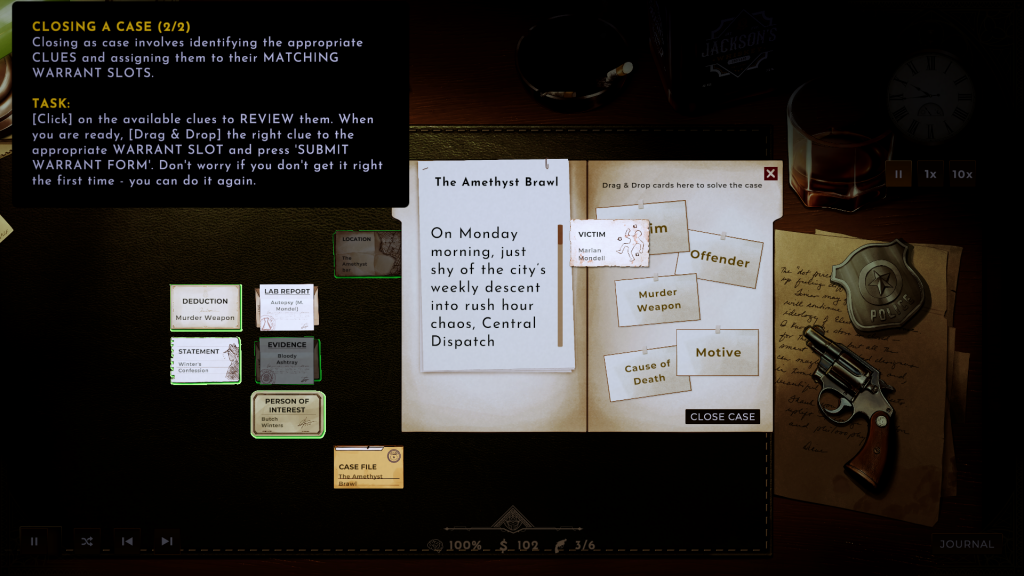
Couple this with Sam Carter’s own ‘demons’ – his experience in the war, the collapse of his career, and his descent to the bottle. So everything adds up to how the mystery is experienced. We understand, however, that each player may have different expectations, so we also provide three game modes that provide a different experience. For example, in ‘Story’ mode, the impact of time and sanity on the gameplay is minimal, while in ‘Gumshoe’ mode, there are limited assists, and the game takes place in real time, and time is relentless!
Along with these scheduling methods, there is also a sanity mechanic, which requires the player to resort to methods like alcohol, similarly to what a noir detective is stereotyped for. Can you tell us how you were able to apply this mechanic while also being sensitive to the situation at hand?
Sanity is affected by certain choices within the game, but also by other economic elements like money. For example, using your magnum to intimidate suspects and extract confessions will have an impact on your sanity. So is staying sober for consecutive days. So, players are required to avoid consistently taking the ‘easy’ way out and to try to make enough money during the day (by progressing the investigation) to pay their bar bills. Of course, there will be points in the investigation where madness will intentionally creep in anyway, as long as these conditions are met, you will be able to keep your mental state stable.
Throughout Obsidian Moon, players will come across various cases that will each impact the player in their own way, but will any of these cases overlap in any way, or are they all entirely separate with no overlapping features?
As discussed previously, Obsidian Moon will have 7 main cases plus 3 side cases. There is an underlying plot that connects all main cases, and as the investigation progresses, players will start seeing connections. There will be twists and turns, points where character roles become clearer, as well as a climactic ending with an ultimate choice, but I cannot say much more.
During the development of Obsidian Moon, were there any game mechanics or stories that were left on the cutting room floor, or have you managed to keep everything you wanted?
Especially on the narrative part, we initially opted for a much more complicated mystery, attempting to deliver a novel-level depth to the story. In the end, though, we decided against it in order to reduce complexity and make the game more accessible. Other than that, during the prototyping stage, we tried many different techniques and mechanisms for the game’s card-based gameplay loop, but the overall vision has remained stable throughout the development.
One particular mechanic that we have changed quite a lot was Journaling, which started as a log of actions executed during the game versus its current state, which is more like an actual investigation journal that reveals the key plot point of the investigation. For sure, as we race towards the final release, there are still moving pieces, things that we can (and will) improve, as well as some new features that will improve the experience overall.
Can you tell us what you think helps Obsidian Moon stand out amongst the other detective games that are out there?
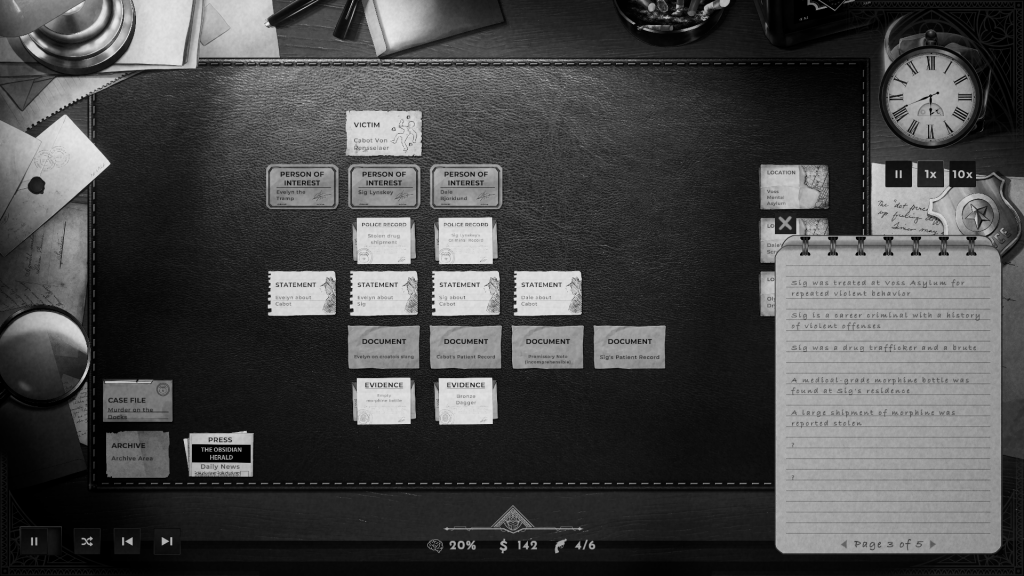
We believe that Obsidian Moon is unique in its own accord because it gives players freedom to investigate their way, make their own choices, and make mistakes. More than this, it is also the blend of Lovecraftian cosmic horror with chthonic elements of ancient Minoan and Kawirian belief systems in a ‘traditional’ Noir setting that makes Obsidian Moon a fresh, compelling addition to the genre. Add this innovative gameplay approach that combines elements of text-based adventure and card/ board-game genres, and I believe that Obsidian Moon is one of the freshest games currently.
What is the proudest moment you have had during the development of Obsidian Moon, whether it be a certain mechanic working better than you expected, a storyline coming together, or even just the release of the game’s demo?
It has to be the initial comments we received when we released the alpha demo to the public for playtest, a few months ago. Receiving a great deal of positive feedback, especially that early, made us realise the potential and somehow validated our vision for the game.
The second moment had to be the most recent release of the beta demo in Steam’s Detective Fest a few days before, where we saw Obsidian Moon trending, receiving constructive feedback, having great download rates and wishlists, and getting increasing coverage. Of course, we do not take all these for granted – on the contrary, it makes us feel more motivated to live up to the expectations and deliver a great game!
One question we ask all the people we interview here at Thumb Wars is, what is one misconception that the outside world has about the world of game development that annoys you?
What an interesting question! Well, from a personal standpoint, before I became a creator myself, I tended to think that having a good idea and passion is enough to succeed – everything else will take its course eventually. There is some truth in this, but the reality is much much harsher; it requires planning, discipline, and deep knowledge of many principles around business and product development. So game development is definitely not as easy as I thought it would be!
For those who are looking to follow your footsteps into developing games similar to Obsidian Moon or within the same genre, is there any advice you would give them to help them get their start?
My advice would be to study the genre and establish a north-star vision on how they would like the game to be about (market research is important here to establish if there is viable demand) and how it would play. There are several first-person or point-and-click detective games out there. If you follow this approach, it is important to establish early how the game differentiates, i.e., what new mechanics it has to offer to the genre.
In parallel to this exercise, the deduction loop needs to be carefully considered – the investigative part can be make-or-break for detective games, so it needs to be engaging and fulfill its purpose. Obviously, world-building elements like characters and atmosphere are very important, as well as the mystery itself and how it is delivered to the player.
At the time of this interview, only a demo has been released for Obsidian Moon, but is there any tease you can provide to future sleuths out there regarding a potential release window?
As we speak, we are targeting late 2026 – early 2027. We will make announcements as long as we have secured a viable release slot!
Is there anything we have missed during this interview that you think our readers would like to know regarding Obsidian Moon
For starters, the demo reception so far has been excellent, so a big thank you for this! Your comments mean so much to us and the game, so keep them coming. Make sure to join us on our social media and Discord server for regular updates and much more. Finally, if you have not already done so, go play the Obsidian Moon demo and wishlist! Thank you all!
For more Thumb Wars Gaming coverage, check out our article talking about the disappointing launch of Dispatch on the Nintendo Switch, or our review of MIO: Memories in Orbit.

Liam is a Senior Editor, Writer, and Critic for Thumb Wars and has been working with the team since day one. Liam is a big fan of all things gaming, as you will catch him playing all of the new releases from every genre you can imagine. Whether you find Liam gaming just for fun or spending his free time streaming, you will always find a smile on his face when it comes to all things gaming.